
By David Pfluger
The Edison Home Kinetoscope is an early film format for home cinema. Using 22mm-wide film, the system was developed by A.F. Gall for Edison (patent no. 1,204,424, granted on November 14 1916 (Ref 1) and was introduced in 1912. It is one of the earliest systems designed specifically for projecting films in the home and should not be confused with the Edison Kinetoscope of the 1890s, which was a peep-hole viewing device rather than a projection system.
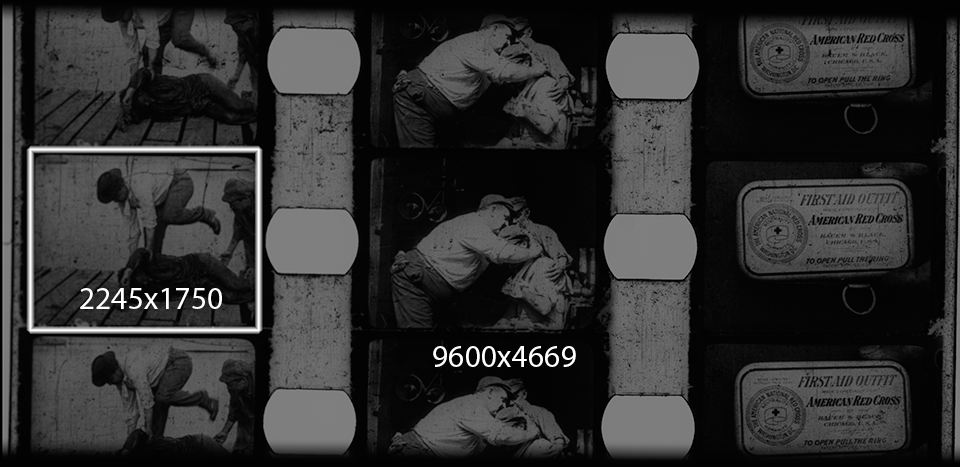
The Edison Home Kinetoscope format is characterised by its unusual film width, perforation pattern, and image layout. Three separate image sequences are printed parallel to each other across the 22 mm film strip, dividing the film horizontally into three equal parts (Image 1).

Image 1: A set of three images from FIRST AID TO THE INJURED from the collection of Lichtspiel – Kinemathek Bern. The two outer image sequences of the 22mm Edison Home Kinetoscope film run top to bottom, whereas the center sequence runs bottom to top.
The specially designed projector was a mechanically sophisticated device that played the three image sequences consecutively. First, the film runs forward to project the right-hand sequence; the mechanism then shifts horizontally to the center sequence and runs the film backward; finally, it shifts to the left sequence and runs forward again. Two rows of perforations divide the three image sequences. This unusual format – both in width and perforation placement – makes digitisation on conventional film scanners impossible. Scan2Screen’s modular and versatile approach provides a solution, allowing these rare films to be scanned at high quality.
This novel spatial configuration was not the only distinctive feature of the Edison Home Kinetoscope. Commercial film prints were produced not on cellulose nitrate, but on cellulose acetate – a significantly safer base material, introducing ‘safety film’ to the market. Alongside Pathé’s 28 mm film format, Pathé Kok, also introduced in 1912, the Edison Home Kinetoscope represented one of the earliest attempts to protect home users from the danger of nitrate film.
Film content for the system could only be purchased pre-produced, as no cameras were ever made for recording directly in the 22mm format. It was never intended as a capture medium for amateur filmmakers. Instead, titles were initially shot in 35 mm and then reduction-printed onto the 22 mm film stock.
With individual image dimensions of 5.1 x 3.9 mm (Ref 2), the frame size sits between that of 8 mm film (4.5 x 3.3 mm) and Super 8 (5.8 x 4.0 mm). These later formats became standards for amateur and home cinema 23 years later (8 mm) and 53 years later (Super 8) after the introduction of the Edison Home Kinetoscope.
Three different light sources were available for the projector: a small carbon arc lamp, a Nernst lamp, and an acetylene burner (Ref 2). Scan2Screen has spectrally measured all three of these historical light sources and can reproduce their individual spectral characteristics when rendering the scanned image data with Scan2Screen’s proprietary rendering software. (Ref 4)
Likely due to the relatively high cost of the system, the Edison Home Kinetoscope was never widely adopted, and production was discontinued as early as 1914. However, its early introduction of the format in 1912 and the reuse of existing Edison titles meant that some films survived in the 22 mm format that might otherwise have been lost (Ref 2, 3).
Edison Studios released a catalogue of over 260 titles for the Home Kinetoscope. Two of these were handed over to Scan2Screen by Irela Núñez del Pozo of the Archivo Peruano de Imagen y Sonido for digitisation. They may be among the earliest surviving film documents ever recorded in Peru: CHUNCHO INDIANS OF THE AMAZON RIVER, PERU’ and AN OLD SILVER MINE IN PERU. Both films were originally produced in 1910 and made available to amateurs in 1912 in Edison Home Kinetoscope 22 mm format.
Due to their age, heavy wear, numerous torn perforations, digitising these films posed a significant challenge. Lutz Garmsen, Scan2Screen’s systems engineer, adapted the optical control of the film transport system to accommodate the format’s unique requirements. Even with precise stabilization based on the perforations, image instability remained visible – an artifact introduced by the original reduction-printing process from 35 mm film.
10 second extract of the film AN OLD SILVER MINE IN PERU (USA 1910).
9.6K scan of the 22 mm Kinetoscope by Scan2Screen.
Courtesy of Archivo Peruano de Imagen y Sonido.
10 second extract of the film THE CHUNCHO INDIANS OF THE AMAZON RIVER, PERU (USA 1910). 9.6K scan of the 22 mm Kinetoscope by Scan2Screen.
Courtesy of Archivo Peruano de Imagen y Sonido.
By scanning the material edge-to-edge at a resolution of approximately 9.6 K, Scan2Screen is able to deliver just under 2K of resolution per individual image sequence – an exceptionally generous result for a format of this age and complexity.
References:
1 Weissman, Ken, O’Farrell, William (2002): “Restoring 22 mm Edison Home Kinetoscope Films”. In: The Moving Image. The Journal of the Association of Moving Image Archivists, University of Minnesota Press, Vol. 2, No. 2, pp. 137-141 (https://www.jstor.org/stable/41167088)
2 Kattelle, Alan D. (2002): “The Edison Home Kinetoscope and Its Films”, In: The Moving Image. The Journal of the Association of Moving Image Archivists, University of Minnesota Press, Vol. 2, No. 2, pp. 121-128 (https://www.jstor.org/stable/41167086)
3 SMALL GAUGE WORKING GROUP (2002): “Edison Home Kinetoscope (22mm): A List of Films and Sources”. In: The Moving Image. The Journal of the Association of Moving Image Archivists, University of Minnesota Press, Vol. 2, No. 2, pp. 128-136 (https://www.jstor.org/stable/41167087)
4 Flueckiger, Barbara, Trumpy, Giorgio, Garmsen, Lutz, Pfluger, David, Weiss, Martin, Muschaweck, Julius (2025): “The Case for Multi-spectral Scanning of Historical Colour Films”. In: Journal of Film Preservation, No. 112, 04.2025, pp. 68–80. (https://www.zora.uzh.ch/id/eprint/277532/)
 Scan2Screen
Leave a comment