
At Scan2Screen we love every type of (color) film, but we have always been especially passionate about experimental films – whether in color or black-and-white.
Starting in the 1920s the German Absolute Film movement explored applied colors in filmmaking. Influenced by abstract art, these films emphasized color, shape and movement as core aesthetic elements. In accordance with modernist art, avant-garde filmmakers also paid close attention to the materiality of film itself and how it appeared onscreen.
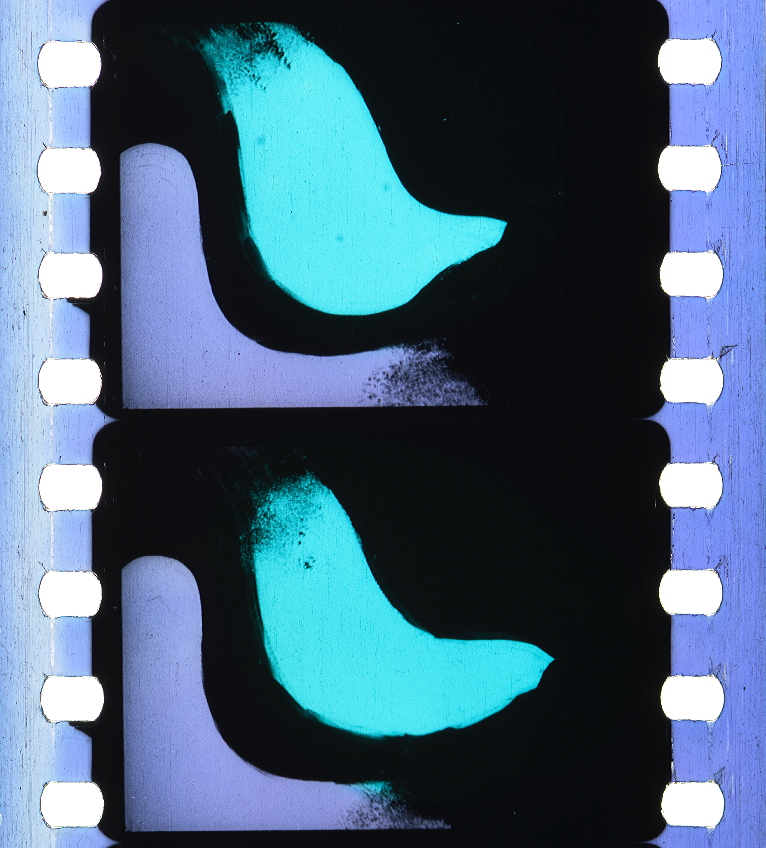
(DEU 1922, Walter Ruttmann)
Tinted and hand-colored
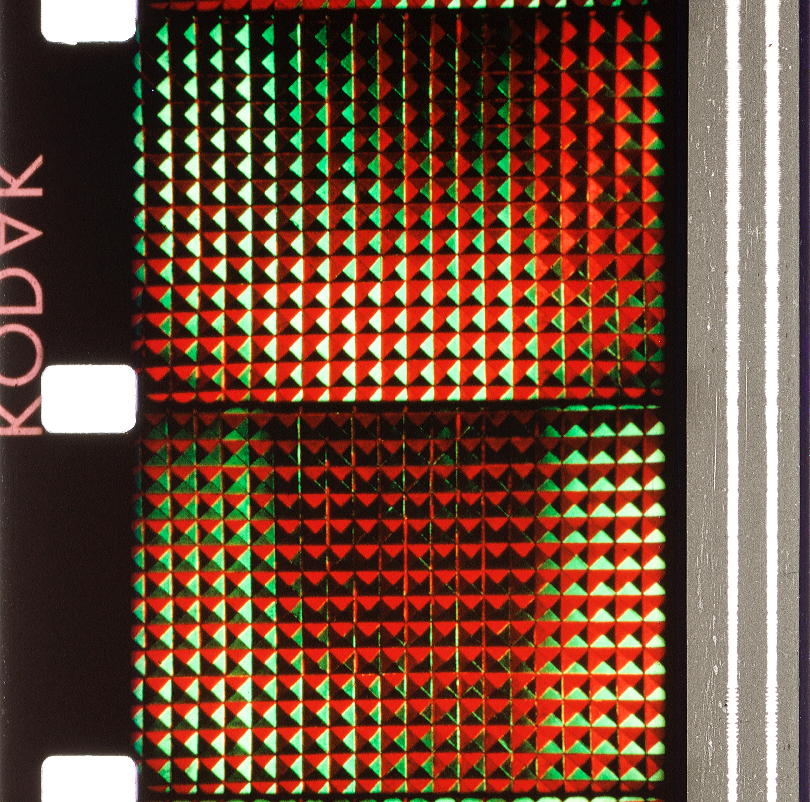
(FRA 1964, Éric Duvivier)
Kodachrome II camera reversal
As mimetic colors – often called “natural” colors – became more widespread in the early 1930s, experimental filmmakers were among the first to embrace and push the boundaries of emerging color technologies , – Gasparcolor, Dufaycolor, Technicolor No. IV and V, and Kodachrome. Notably, Oskar and Hans Fischinger, along with Len Lye, were pioneers in working with Gasparcolor in the 1930s, producing films with brilliantly saturated colors that continue to amaze audiences today. Lloyd Jones experimented with Kodachrome two-color for [KALEIDOSCOPE],while Shigeji Ongino’s Japanese abstract animation 表現 [HYŌGEN – AN EXPRESSION] utilized a unique Japanese variant of Biocolour, an additive color process. In the 1960s, Éric Duvivier created a series of stunning experimental films on Kodachrome.
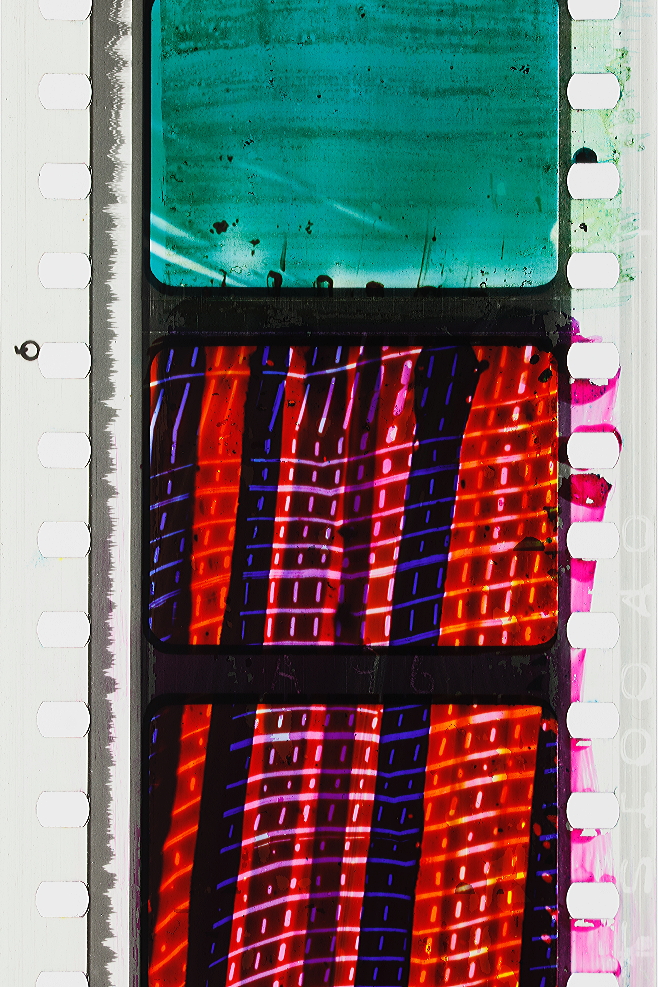
(GBR 1940, Len Lye)
Technicolor No. IV / hand-coloring
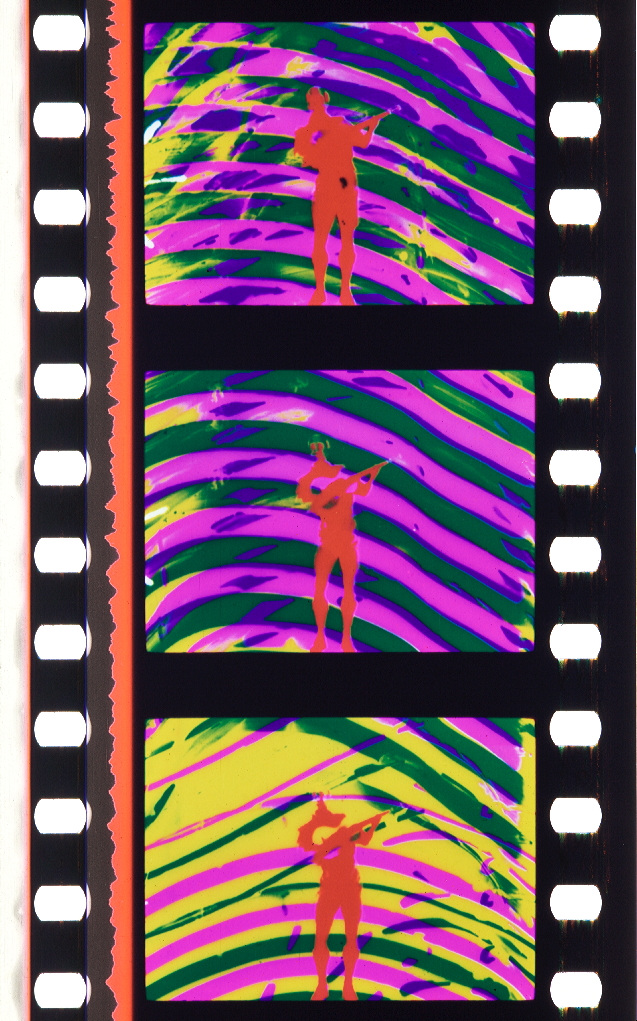
(GBR 1936, Len Lye)
Gasparcolor
Experimental films often employed techniques such as stop motion, direct animation, and hand-painting. However, regardless of the techniques applied, scanning these films presents unique challenges:
- Non-standard dyes and pigments are not well captured by traditional scanners, as they can fall outside the gamut of modern devices.
- Double-coated films are thicker than standard single-emulsion films, making them difficult to handle with conventional scanning equipment.
- Applied objects, scratches and mechanical treatments can be hard or even impossible to capture accurately with traditional scanners
- Perforation areas often contain valuable information about the production process and the material aesthetics of the film.
- Fragile and delicate surface properties can be at risk when scanned with equipment not adapted to their specific material composition.
- Direct animation films are often not segmented into frames, but function as continuous visual compositions.
- Extra dense colors are not well captured by scanners originally developed for camera negatives.
- Non-standard formats and gauges require specialized handling.
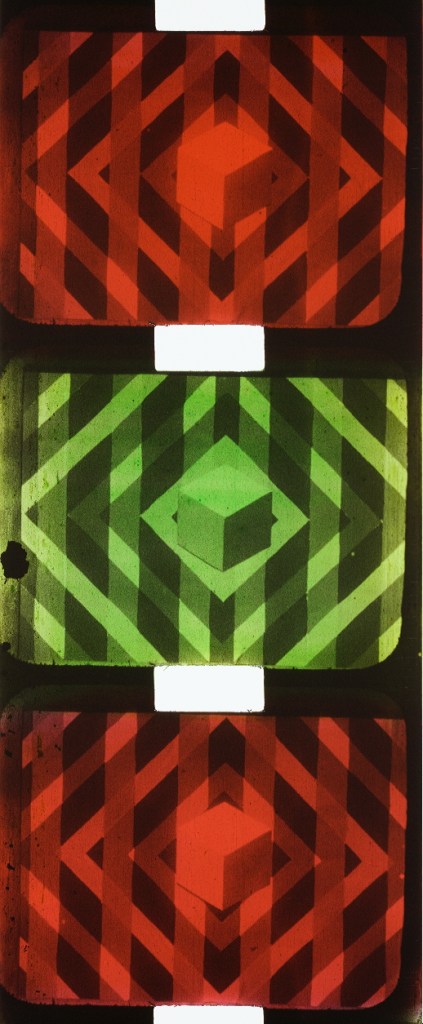
(JAP 1935, Shigeji Ogino)
Tachibana 9.5 mm
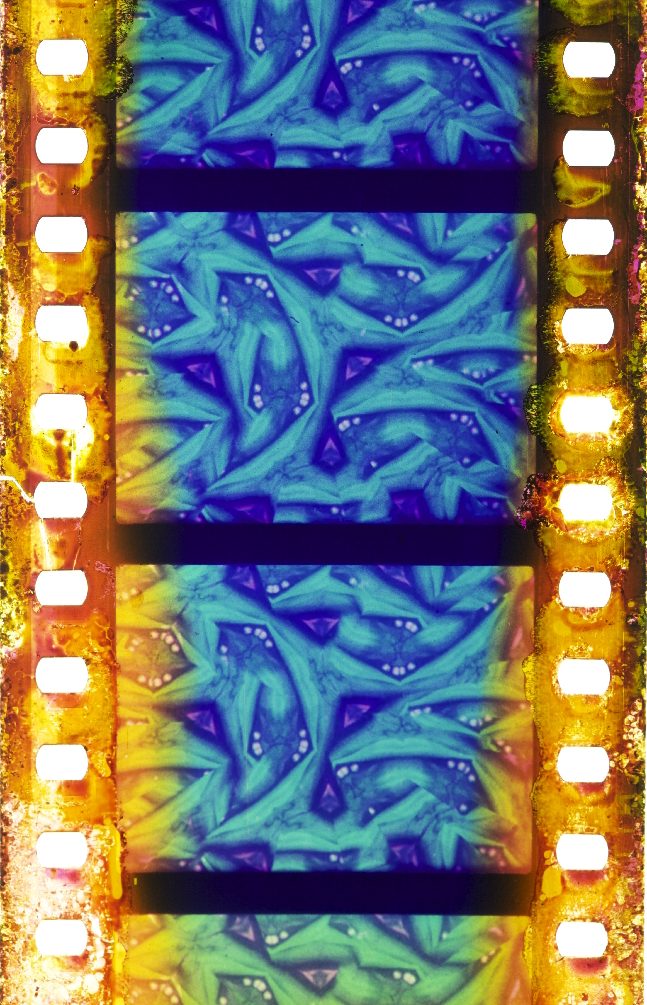
(USA 1927, Loyd A. Jones)
Kodachrome Two-Color
Scan2Screen’s versatile multispectral scanner is uniquely designed to address these challenges:
- Multispectral illumination and capture ensure that all color information is accurately recorded, even if it falls outside the gamut of current devices and color spaces, preserving even the most unusual hues present in a film element.
- No gate, no capstan rollers, and extra wide angles prevent any damage to even the most fragile surfaces, including films with applied objects or paint.
- Extremely low tension to safely transport brittle films.
Accommodates any film stock thickness for comprehensive scanning capabilities. - Full-width scanning and overscan provide a complete representation of the film object for any display format.
- Supports all film gauges between 8mm and 35mm.
- Manual frame-by-frame scanning is available for safe digitization of extremely damaged or brittle films.
- Adjustable diffuse and directed (collimated) illumination optimally captures unusual material compositions and renders them in projection light.
- Scientifically accurate color reproduction delivers unmatched color fidelity.
At last year’s AMIA Conference in Milwaukee, we demonstrated our technology by scanning Ursula Helfer’s stunning hand-painted direct animation LUKAS KLEINE WELTMASCHINE. The difference between directed and diffuse illumination was striking, with collimated lighting revealing additional details and enhancing the final rendering.
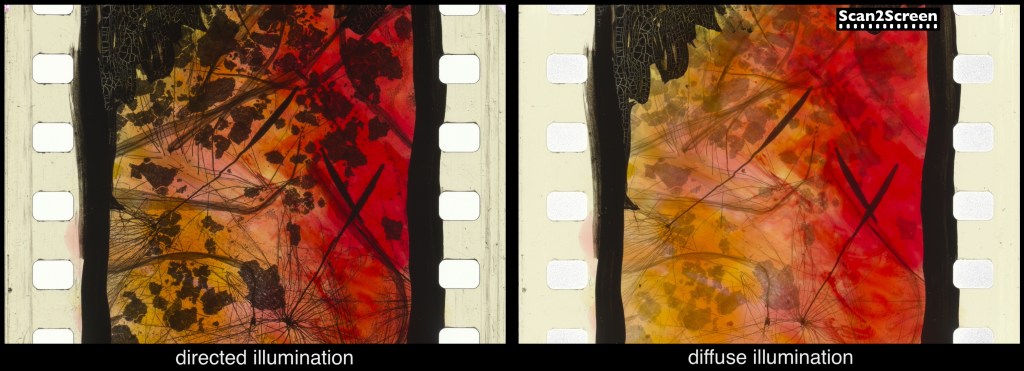
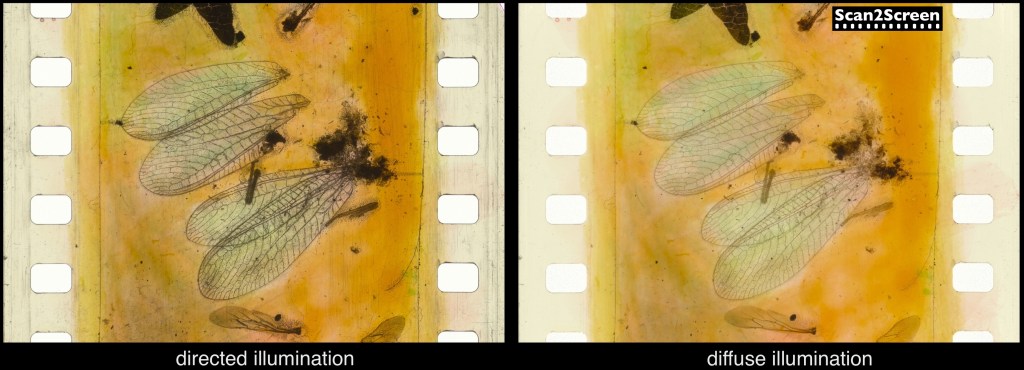
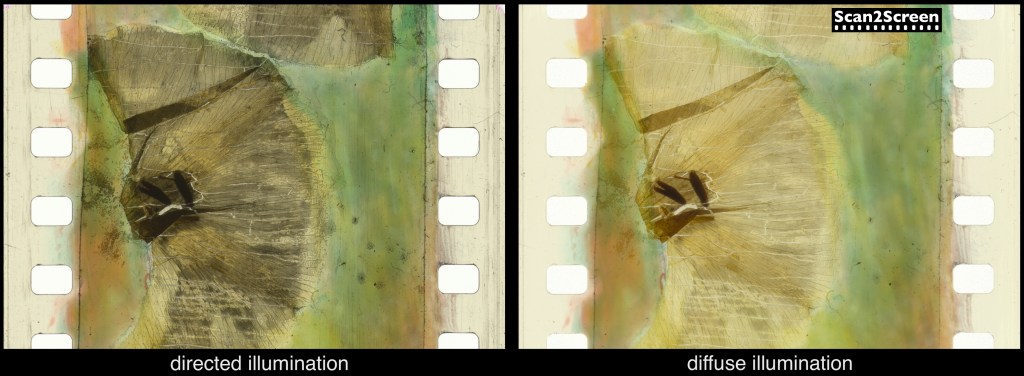
LUKAS KLEINE WELTMASCHINE (DEU 1993, Ursula Helfer).
Hand-colored experimental film, multispectral scan by Scan2Screen / Lutz Garmsen
Do you have experimental films in your collection?
Fill out our questionnaire or contact us. We would love to provide the most beautiful scans for your unique experimental films.
Image Credits
All photos of original prints from the Timeline of Historical Colors in Photography and Film:
DAS WUNDER (GER 1922, Walter Ruttmann). Credit: Bundesarchiv Filmarchiv. Photograph of the hand colored and tinted nitrate print by Olivia Kristina Stutz, ERC Advanced Grant FilmColors.
HYOGEN, AN EXPRESSION (JAP 1935, Shigeji Ogino). Credit: National Film Archive of Japan. Photographs of the 9.5 mm Biocolour print by Barbara Flueckiger.
[KALEIDOSCOPE] (USA 1927, Loyd A. Jones). Credit: George Eastman Museum. Photographs of the Kodachrome two-color double coated stock by Barbara Flueckiger.
RAINBOW DANCE (GBR 1936, Len Lye). Credit: BFI National Archive. Photographs of the Gasparcolor nitrate print by Barbara Flueckiger.
MUSICAL POSTER NUMBER ONE (GBR 1940, Len Lye). Credit: Museum of Modern Art Department of Film. Photographs of the Technicolor dye-transfer nitrate print by Barbara Flueckiger.
LA PERCEPTION ET L’IMAGINAIRE (FRA 1964, Éric Duvivier). Credit: Image’Est. Photographs of the Kodachrome II camera reversal by Bregt Lameris, ERC Advanced Grant FilmColors.
 Scan2Screen
Leave a comment