
By David Pfluger
Agfacolor lenticular film was one of the earliest commercially available color films, developed by Agfa in the late 1920s and released to market in 1932. It used an innovative optical system to reproduce colors on the screen. However, when viewed under regular conditions, the film itself appeared similar to black and white film.

Source: Eggert, John (1932): Kurzer Überblick über den Stand der Farbenkinematographie. In: Bericht über den VIII. Internationalen Kongress für wissenschaftliche und angewandte Photographie, Dresden 1931, pp. 214-222. Leipzig: J. A. Barth.
As a lenticular film, Agfacolor had a surface covered in tiny lenticules running along the film strip. When paired with an RGB filter on the camera’s lens during recording and the same filter during projection, the film could capture and reproduced a full spectrum of colors based on the red, green, and blue filters used.
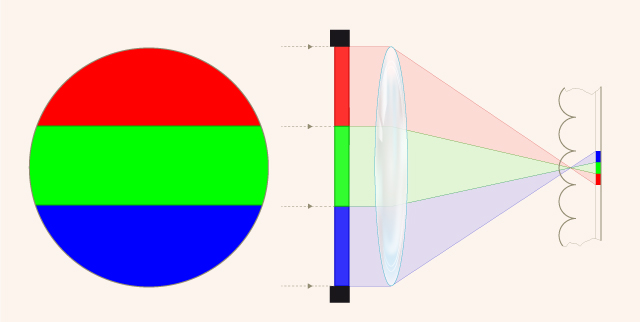
filter (left), lens (middle), lenticules on the film (right)
Credit: Illustration by Sarah Steinbacher, Multimedia & E-Learning-Services, University of Zurich. Source: Ede, François (1994): Jour de fête ou la couleur retrouvée. Cahiers du Cinéma: Paris.
This system was known as “Agfacolor Schmalfilm 16mm” when it became commercially available. It was a direct competitor to Kodak’s Kodacolor lenticular film, which worked identically and had been on the market since 1928. Agfacolor offered superior image resolution because its lenticules were 50% smaller than those used in Kodacolor . Despite its technical advantages, Agfacolor Schmalfilm 16mm was not a commercial success. Sales were slow in pre-war Germany, and it was deemed unsuitable for the National Socialist’s propaganda because it rendered the color red with a brownish hue, undermining the impact of the red Nazi flag.
Interestingly, Agfa itself undercut the success of its lenticular film by releasing Agfacolor-Neu, a chromogenic film material, just 5 years later in 1937. Production and sales of the lenticular film ceased immediately.
Today Agafcolor lenticular film surfaces in archives only rarely. Its resemblance to ordinary 16mm black-and-white film makes identification more difficult.
The Scan2Screen team was fortunate to discover fragments of the film in the collection of Erhard Finger, the author of In Farbe – Die Agfa-Orwo-Farbfotografie [In Color – The Agfa-Orwo Color Photography]. In his book, Finger dedicates chapter 5 to Agfa’s lenticular color technologies. One particularly interesting sample, kindly provided to the Scan2Screen team, was shot by Dr. Gerd Heymer, one of Agfa’s key figures behind Schmalfilm 16mm. It captures an athlete performing a routine on the pommel horse under open skies during the 1936 Olympic Games.
Lutz Garmsen, Scan2Screen’s Hardware and Systems Engineer, was key in developing the so-called “slit scan” technique used to capture lenticular materials, achieving excellent results with the Agfacolor samples.
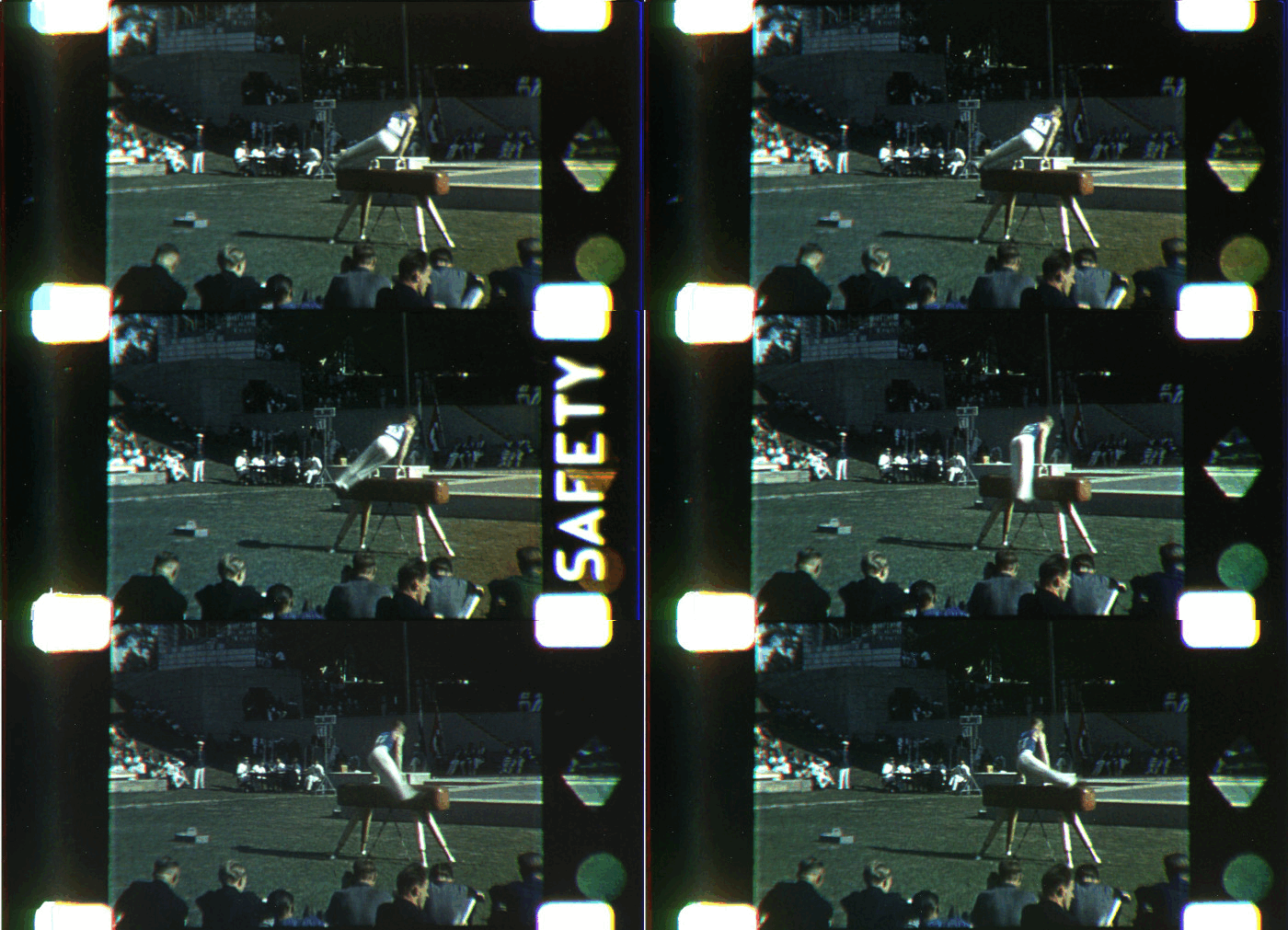
by Lutz Garmsen, Scan2Screen,
with the slit scan technology.
The slit scan technique is one of two methods used by Scan2Screen to extract color from lenticular film. The first method is analog, which uses the historical optical process to sequentially expose the three color separations onto the camera sensor. The second, digital approach, uses AI to analyze and decode the color information from a very high-resolution scan of the silver image in the emulsion. A combination of both methods – analog slit scan and digital scan of the black-and-white emulsion – provides an archival-grade information package that meets the standards for accessibility and long-term preservation in line with restoration ethics.
For further information, visit the Timeline of Historical Film Colors:
Lenticular color film: https://filmcolors.org/cat/lenticular-screen/
Kodacolor: https://filmcolors.org/timeline-entry/1240/
Agfacolor: https://filmcolors.org/timeline-entry/1262/
 Scan2Screen
Leave a comment